Ownership
Electric Scooter Parking Security: Plan the Place, Lock and Routine
Plan suitable locks, permitted parking and a repeatable security routine, while checking accessory compatibility and avoiding theft-proof promises.
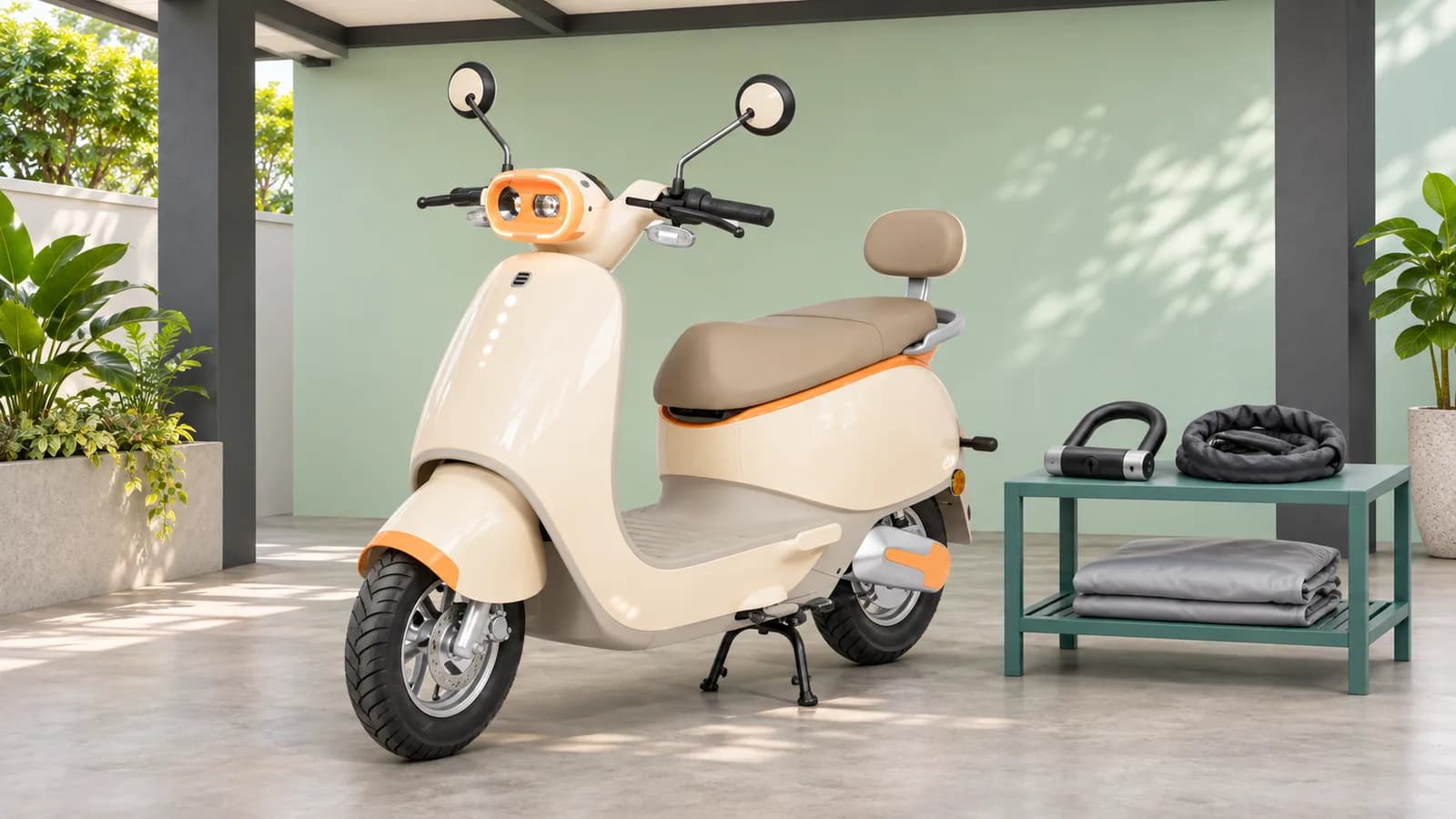
Plan scooter parking security around a permitted parking place, suitable physical security and a repeatable routine. Do not rely on a product photograph or a single feature as a promise against theft. Check any lock or accessory against your scooter's manufacturer instructions, and ask for fitting advice if you cannot establish that it is suitable.
This guide does not claim that a Dynamo scooter includes an alarm, tracker or particular locking system. The cover is a conceptual illustration; its loose security props are not tested accessories or a fitting demonstration.
What can I learn from police security guidance?
Police.uk's motorcycle, moped and scooter guidance recommends combining security measures instead of depending on a steering lock alone. It discusses locks, chains, covers, removing keys and choosing an overlooked, well-lit place. It also makes clear that security measures cannot guarantee a vehicle will not be stolen.
That is UK crime-prevention guidance. It is not an Indian parking rule, an insurance condition or approval of a lock for your Dynamo model. Do not transfer a fitting example to a scooter with different components. Use the principle of layered security while checking the actual equipment and local permission separately.
How should I assess my usual parking place?
Visit the space you expect to use, not just a space that looks convenient on a map. Establish whether you have permission to park there and whether any proposed anchor point is approved for that purpose. Do not attach a scooter to equipment, doors or structures simply because a chain can reach them.
- Keep entrances, walkways and shared access clear.
- Ask who controls access to the parking area.
- Consider visibility and lighting when you normally return.
- Ask about any building restriction on covers, locks or fixed anchors.
- Keep security planning separate from permission to charge there.
For shared-building arrangements, use the apartment parking discussion checklist alongside this guide. A building's agreement to parking does not automatically establish that an electrical installation or charging arrangement is suitable.
What should I check before buying a lock?
Ask whether the proposed product is appropriate for the scooter's actual components and the parking arrangement. Do not assume that a lock shown on a different vehicle can be fitted in the same way. Keep any supplied instructions and ask how to avoid contact with parts that the lock is not designed to secure.
| Decision | Question to resolve | What not to assume |
|---|---|---|
| Lock suitability | Does the product fit the intended point without damage? | Similar-looking scooters have identical attachment points |
| Fixed security | Is the anchor permitted and suitable for this purpose? | Any railing is an authorized anchor |
| Daily handling | Can I carry and use the product as instructed? | A heavy item is safe loose in any storage space |
| Cover | Is it suitable for the vehicle and the conditions of use? | A cover guarantees theft protection |
| Additional electronics | Has the manufacturer confirmed the proposed fitting? | An alarm or tracker can be wired in without checking |
| Recovery information | What identification and purchase records can I keep privately? | Publishing identifiers improves security |
If a product needs changes to electrical equipment or bodywork, obtain manufacturer guidance before proceeding. This is not a wiring, drilling or lock-installation tutorial. The accessory compatibility guide can help frame the questions without assuming an accessory is approved.
What belongs in a daily parking routine?
Create a short routine that suits your actual equipment. Park in the agreed place, secure the vehicle using suitable products according to their instructions, remove and retain the key, and make a final check before leaving. Before using the scooter again, remove any external security devices and check that nothing has been left where it could interfere with operation.
Store spare keys and security details thoughtfully. Avoid leaving a spare with the vehicle or posting an image that exposes key identifiers. If a key is missing, the lost-key support checklist describes what to ask the manufacturer rather than suggesting a bypass.
What should I record privately?
Keep purchase and identification documents, relevant photographs and security-product information in a private place. If something happens, follow the appropriate local police process and contact any insurer that applies to your circumstances. Do not confront someone attempting theft or rely on an app or tracker as a reason to put yourself at risk.
For model-specific equipment questions, use Dynamo support. No recovery service, insurance outcome or theft-proof performance is promised by this article.
Frequently asked questions
Is a steering lock enough on its own?
The cited police guidance advises against relying on it alone. Consider suitable additional measures, with model-specific fitting and parking permission checked first.
Can I fit any alarm or tracker sold online?
Do not assume compatibility or permission to modify the scooter. Ask the manufacturer about the proposed product and fitting method before authorizing changes.
Does a lock or cover make the scooter theft-proof?
No. Security is about reducing opportunity and improving your routine, not guaranteeing an outcome.