Ownership
Electric Scooter Parking: An Apartment Checklist
Plan the parking bay, entry route, permissions and security routine before bringing an electric scooter home to an apartment or shared building.
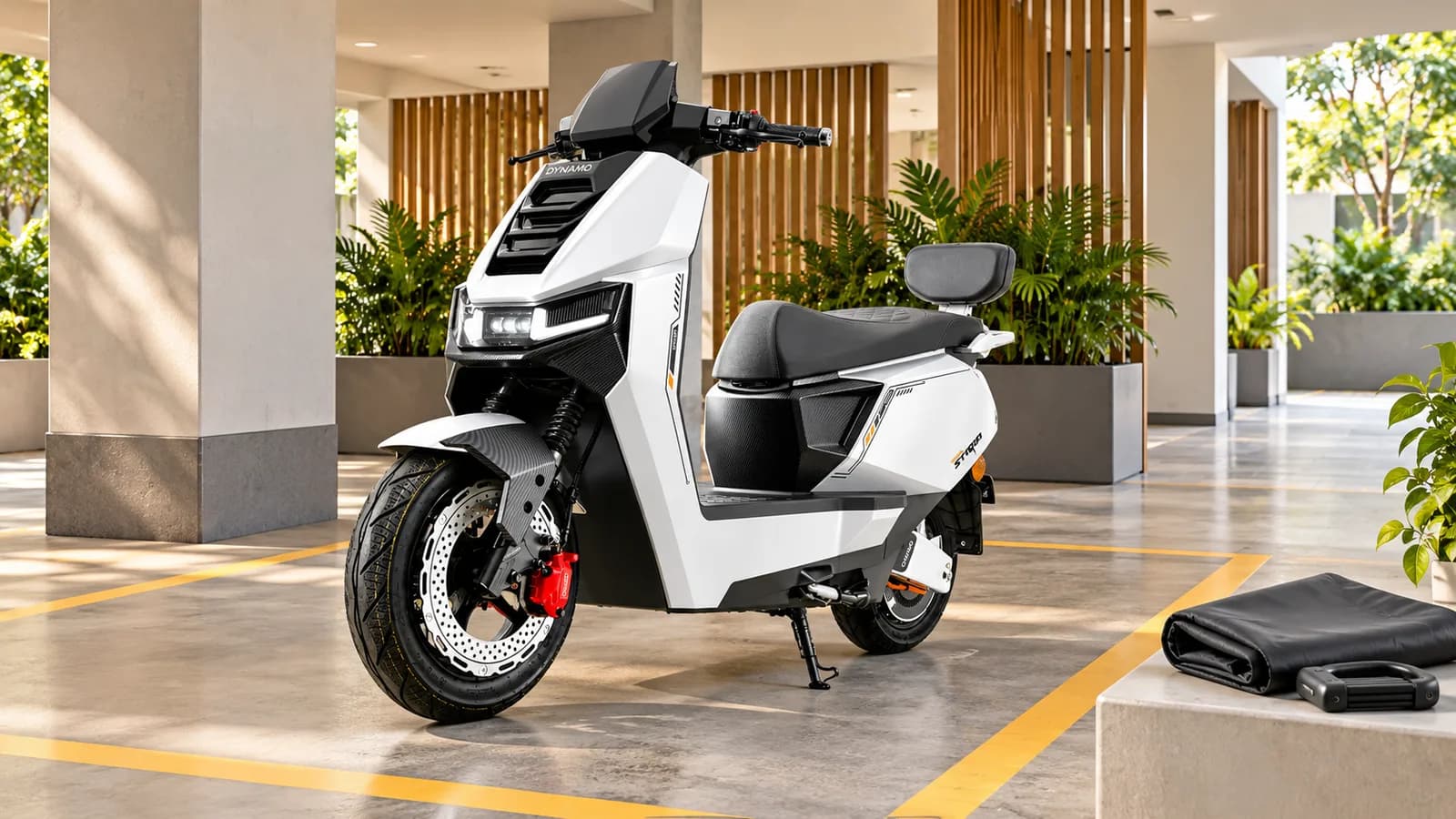
Electric scooter parking at an apartment needs more than a vacant corner. Confirm that the building permits the space, check the full entry route and allow room to park and leave without blocking other people. Decide where the keys and approved security accessories will go. Treat any charging arrangement as a separate electrical and building-permission question, not something automatically included with a parking bay.
Use this Dynamo EV checklist before delivery, a house move or a change of parking space. It is a planning aid, not a statement of building rules, an electrical installation guide or a guarantee against theft. The right arrangement depends on the actual property and vehicle. Ask building management and your dealer to resolve anything that cannot be confirmed from the documents or a site visit.
Will the scooter fit the whole route, not just the bay?
Start at the entrance you will normally use. Identify the gate, turns, doors, columns and other vehicles between that point and the proposed bay. Measure any narrow point and compare it with confirmed dimensions for the exact scooter. Include the space required to turn and park; do not assume that fitting between two walls means the route will be comfortable to use.
Ask your Dynamo dealer to demonstrate parking and handling during your appointment. Explain the difficult part of your route, such as a tight turn beside a column. If the route involves a ramp, an unusual surface or lifting the scooter, ask for model-specific advice instead of treating a catalogue photograph as proof that it will work. Do not conduct an improvised lifting or ramp test.
What permission should I confirm with the building?
Ask the person authorised to allocate parking to identify the exact space you may use. Confirm how access works at the times you actually leave and return, whether visitors share the area and whom to contact if another vehicle occupies the bay. A verbal suggestion from a neighbour is not the same as confirmation from the building's responsible contact.
Use a short written record rather than collecting vague assurances. If there are conditions you do not understand, ask for clarification before arranging delivery. This guide does not interpret local parking law or grant a right to use common property.
| Question | Confirmation to keep |
|---|---|
| Which space may I use? | Bay or location identified by the responsible contact |
| How do I enter and leave? | Gate access, timing and the person to contact |
| What must remain unobstructed? | The building's designated pedestrian and access routes |
| Can an accessory be fitted? | Permission for any proposed anchor or installation |
| Is charging permitted here? | Separate approval and an assessed electrical arrangement |
| What if the space changes? | A contact and an agreed alternative process |
How can I assess the parking position?
Look at the actual position with neighbouring spaces in normal use, not only when the area is empty. Consider whether another vehicle's door, a trolley or a building service needs the same space. Ask management to resolve a conflict rather than leaving the scooter where people must move it to pass. Keep the building's required access routes clear.
Ask the dealer to show the parking procedure and stand use described for your model. Check that you can follow it in the proposed space without reaching around a column or another vehicle. Use the vehicle manual for the procedure; there is no universal stand or storage instruction supplied here for every scooter.
What belongs in a practical security routine?
Remove the keys and use the vehicle's lock as instructed. Police.uk's scooter-security guidance recommends layered security rather than relying only on a steering lock, and favours a well-lit, overlooked location when enclosed storage is unavailable. These are general theft-prevention principles from a UK source, not Indian legal requirements or an endorsement of a particular accessory. No lock or parking choice guarantees that theft cannot occur.
Have the dealer confirm accessory compatibility before purchase. Obtain building permission before fitting an anchor or modifying common property. Ask for any installation to be carried out appropriately; do not drill, alter wiring or attach a lock to an unapproved vehicle part based on this article. Add a visible reminder to remove fitted security accessories before moving the scooter, following their instructions.
Does a parking space also make a suitable charging space?
Not automatically. Ask a qualified electrician to assess a proposed supply and installation, and obtain the required building approval. Do not stretch an improvised cable across a shared walkway. Our separate apartment charging guide lists the planning questions to raise; it is not permission to modify the property.
The U.S. Consumer Product Safety Commission's charger guidance warns that a plug fitting does not establish charger compatibility. It advises using the supplied charger or a manufacturer-approved replacement, being present during charging and following the manufacturer's instructions. This is general safety guidance, not a claim that a particular parking installation or Dynamo variant has been certified by that agency.
What should I arrange before a longer absence?
Check the vehicle manual's storage instructions for your model and battery option. Ask authorised support to clarify the required charging or inspection routine before you leave. Do not copy a storage charge percentage, disconnection procedure or schedule from a different battery type. The CPSC also advises following the manufacturer's guidance when a device is not used regularly and not leaving charging unsupervised.
Keep keys, purchase records and the support contact somewhere you can find them after returning. If somebody will look after the scooter, give them the relevant written instructions rather than asking them to experiment with controls or a charger. Discuss any proposed movement of the scooter with that person and building management in advance.
A parking handover check you can use
Before bringing the scooter home, confirm these points with the people responsible:
- The permitted bay and normal entry route are identified.
- Model dimensions and any difficult manoeuvre have been discussed with the dealer.
- Shared access remains clear when neighbouring spaces are occupied.
- The parking and stand procedure is understood from the vehicle instructions.
- Keys and any compatible security accessories have a consistent storage place.
- Charging permission and the electrical assessment are handled separately.
- Building and dealer contacts are saved for a parking or vehicle concern.
If one answer is missing, record who will confirm it and when you will follow up. A small unresolved question about access is easier to address before delivery than after the scooter arrives at a locked gate.
Common apartment-parking questions
Is there a universal minimum bay size for every Dynamo scooter?
No dimension is claimed in this guide. Use verified dimensions for the exact model and assess the complete entry and parking movement at your property.
Can a security accessory guarantee protection?
No. Confirm compatibility, follow the accessory instructions and consider several appropriate layers of security. Do not interpret an accessory recommendation as an insurance promise.
Should I arrange charging before choosing the bay?
Consider both needs together, but obtain separate confirmation for the space and electrical arrangement. A convenient socket is not proof of permission or suitability.
Browse the Dynamo model catalogue, then take the unanswered parking questions to your dealer. For the vehicle's arrival, use the delivery and handover checklist alongside your confirmed building arrangements.